
DataJewellers
Jewellery management software for Nepal.
Run your jewellery business beautifully.
DataJewellers is jewellery business management software from Data Doodles Tech, Kathmandu, for jewellers who sell by weight: stock by weight and purity, bills priced from today’s rate, purchases, karigar jobs, repairs, old jewellery, barcode tags, customer dues, supplier balances and branch stock — one record that agrees with itself, reported the way your accountant asks for it.
Setup is guided, your opening stock can come in from a spreadsheet, and your records stay yours: you can export them whenever you want.
Live Nepal rates
What gold and silver cost today.
24K Gold
22K Gold
Silver
One product, every part of the business
Follow a piece from the shelf to the ledger.
Six real screens, connected — not seven modules sold apart.
Inventory
Know every piece you hold.
Every item by weight, purity and location, under a code that follows your own categories — gold at 22K, 21K and 18K, silver on its own rate.
Barcode
One scan finds the piece.
Printed tags carry a CODE 128 barcode, read by a phone camera or a USB scanner — no typing an item code by hand.
Sales & POS
Sell faster, at the counter.
Scan a tag, price it from today’s rate, take the payment and issue the VAT invoice — making, wastage and stone value each on their own line.
Workshop
Metal out, metal back, weighed both ways.
Every karigar job carries a state and a balance, so metal issued to a workshop and what comes back are reconciled before anyone is paid.
Finance
The counter and the books agree.
Cash & bank, cash closing, bank reconciliation and expenses — a sale posts its own balance, so the day’s cash matches the ledger without re-entry.
Reports
See the business, not just today.
Registers, ledgers and valuations by Nepali fiscal year, exportable to CSV, Excel and PDF — the numbers your accountant actually asks for.
The daily reality
Nothing is missing.
It is kept in too many places.
You know your shop better than any software ever will. The difficulty was never knowledge. It is that one simple question sits in four different books.
- Stock
- Pieces in, pieces out, old jewellery traded, something sent to the workshop — and the register is a day behind by lunchtime.
- Gold, silver, precious metals & diamonds
- Gold at 22K, 21K and 18K, silver on its own rate, diamonds and other precious materials, with weights and values kept precisely.
- Sales
- A bill is priced from the rate somebody read out this morning, and the discount is argued from memory.
- Purchases and suppliers
- What came in is in one book, what is still payable is in another, and they are reconciled when there is time.
- Customers
- A part payment on Tuesday, the balance promised for Friday, written on the back of the copy.
- Workshop and karigars
- Metal went out. Something came back lighter. The difference is settled by conversation.
- Repairs and old jewellery
- A customer’s own ring is on the bench beside stock that is for sale.
- Branches
- The second showroom rings to ask what is left in the vault, and someone walks to look.
- Reporting and control
- At month end the VAT figures are assembled from paper, twice, to be certain.
What DataJewellers does about it
One record for the shop, and it stays right on its own.
One record for the piece
Weight, purity, cost, branch and history live on the piece itself, so stock, billing and valuation are reading the same line.
The arithmetic is done for you
Fine weight from purity, making and wastage, today’s rate, VAT — worked out on the screen while the customer watches.
Every ledger updates itself
A sale takes the piece out of stock and posts the balance. A purchase moves the supplier. Metal with a karigar stays visible until it comes back.
One place to look
What you hold, what you are owed, what you owe and what is still on the bench, for one branch or for the whole business.
What is inside
Everything a jewellery business runs on, in one system.
Not modules to buy separately. One product, and a shop gets all of it.
Jewellery Inventory
Every piece by weight, purity and location, under an item code that follows your own categories.
Sales & POS
Scan a tag, price it from today’s rate, take the payment and issue the VAT invoice.
Purchases
Record what came in with weight, purity, making and wastage on every line.
Suppliers
A ledger for each supplier, with payments set against the invoices they clear.
Customers
Purchases, repairs, orders and outstanding dues, kept against the person who bought.
Workshop
Metal issued and metal received back, weighed both ways before anyone is paid.
Karigar Jobs
Every job carries a state and a balance, so pending work is a list and not a worry.
Repairs
A customer’s own piece is kept out of saleable stock until it goes home.
Old Jewellery
Exchange taken over the counter, valued at its own purity and credited against the bill.
Stock Transfers
Move pieces between branches with both sides recorded, so nothing is counted twice.
Reports
Registers, ledgers and valuations by Nepali fiscal year, exportable to CSV, Excel and PDF.
Barcode Scanning
Printed tags carry a CODE 128 barcode, read by a phone camera or a USB scanner.
Multi-branch
Each showroom keeps its own stock and its own figures, under one business.
Business administration
Roles, permissions and a record of who changed what, kept for you to read.
In more depth: jewellery management software · jewellery ERP · jewellery billing software · jewellery software in Nepal
Your stock
Know every piece you own.
A tilhari is a tilhari. A diamond earring is not filed under jewellery, other. Each piece carries its own code, its category, and the weights that follow from its purity.
Tag a piece with a barcode and a scan brings it up, instead of a search through a register. Opening stock, bulk import from your spreadsheet, transfers and audits are all recorded, so a piece reads back to the day it entered the shop.
What a single piece carries
- Item code
- TIL-000014
- Coded by category, so the code says what it is
- Gross weight
- 48.220 g
- What the piece weighs on the scale
- Net weight
- 44.860 g
- Metal only, once stones are taken out
- Fine weight
- 41.121 g
- Pure metal, from the purity of the piece
- Purity
- GOLD 22K
- Part of the piece, not a note in a field
- Location
- Main Branch · Vault
- The branch, and the tray it sits in
Selling
Make the sale. The rest follows on its own.
Scan a tag and the piece prices itself from today’s rate. Making, wastage, stone value and discount each sit in their own column, so a customer can follow the bill line by line, and so can you.
Finishing the sale takes the piece out of stock, records the payment or the balance, and files the invoice. Old jewellery taken in exchange is valued at its own purity and credited against the sale. A return is a credit note against the original, which is never quietly rewritten.
If the connection drops in the middle of a busy afternoon, the counter keeps billing and the sales sync when the line comes back — with no invoice number used twice.
Kept in order for you
- Inventory & stock
- Purchases & suppliers
- Sales & POS
- Customers
- Workshop & karigars
- Old jewellery
- Branches & staff
- Reports & audit trail
Every part of the business stays connected — from the piece that comes into stock to the piece that leaves the counter, with its history, value and movement kept together.
Buying
Know what came in, from whom, and what is still to pay.
I know the weight, the purity and the price of everything I brought in.
Stock moves only when goods are actually received and checked, so what the system says you hold is what is in the drawer. Every supplier carries a ledger that runs from opening balance through to closing, and a payment is set against the invoice it settles.
A purchase records
- Weight, purity, making and wastage, per line
- Any other charges, kept apart from metal
- The supplier, and the invoice a payment settles
- What is still payable, on a running ledger
- Returns and debit notes, against the original
The workshop
Know what your karigars are working on.
Metal goes out and something else comes back. The weight in between is the part most shops settle from memory, and the part worth the most.
Issued
112.400 g
Metal goes out to the karigar, with the fine weight recorded.
In process
Job KJ-00003
The job has a state, so pending work is a list and not a worry.
Received
109.850 g
What came back, weighed against what was expected.
Settled
2.550 g
The difference is on the screen before labour is paid.
Each karigar carries a balance and a history you can look back through. Customer repairs stay out of saleable stock, because a customer’s own ring must never be sold, and a replacement is recorded against the piece it replaces.
Branches
Know where every piece is, even while it moves.
Showrooms, the warehouse and the vault are real locations, each holding its own stock. A transfer is approved and recorded on both sides, so a piece is never counted twice and never lost between them.
Every report reads for one branch or for the business as a whole. A manager sees what they are responsible for, and nothing further.
| Branch · location | Items | Market value |
|---|---|---|
| Main Branch · Vault | 56 | Rs 3,86,55,649 |
| Main Branch · Counter 1 | 43 | Rs 3,58,03,320 |
| Main Branch · Rack A | 43 | Rs 3,43,91,900 |
| Pokhara Branch · Counter 1 | 13 | Rs 78,22,504 |
| Pokhara Branch · Vault | 10 | Rs 62,21,094 |
Rates and valuation
What you paid, and what it
is worth this morning.
Two different numbers, and both of them matter. Most shops can find one of them quickly and the other not at all. Gold and silver rates come in daily from FENEGOSIDA, and you can set your own rate whenever you prefer.
| Metal · purity | Items | Fine weight | Market value |
|---|---|---|---|
| GOLD 22K | 156 | 3620.56 g | Rs 15,90,23,903 |
| GOLD 21K | 38 | 818.75 g | Rs 3,90,94,631 |
| GOLD 18K | 96 | 642.09 g | Rs 3,48,56,896 |
| SILVER 999 | 15 | 5456.57 g | Rs 28,26,685 |
| SILVER 925 | 15 | 2134.83 g | Rs 10,30,031 |
A stock position from the demonstration business. Market value follows today’s rate for each purity.
Cost stays where you put it
A finished purchase keeps the weight, the rate and the charges it was made with. Last Ashad’s figures still read the way they did last Ashad. What you paid does not drift because the market moved this week.
Value moves with the market
Rates are read per metal and per purity, per tola and per gram, and your valuation follows them. You can see what your shelves are worth right now, beside what they cost you.
You should not have to change how you work.
Tola
and gram, whichever you use
Purity
part of the piece itself
Bikram Sambat
beside the Gregorian date
2082/83
the Nepali fiscal year
NPR
to the paisa, never rounded away
Your categories
and item codes that follow them
Inside DataJewellers
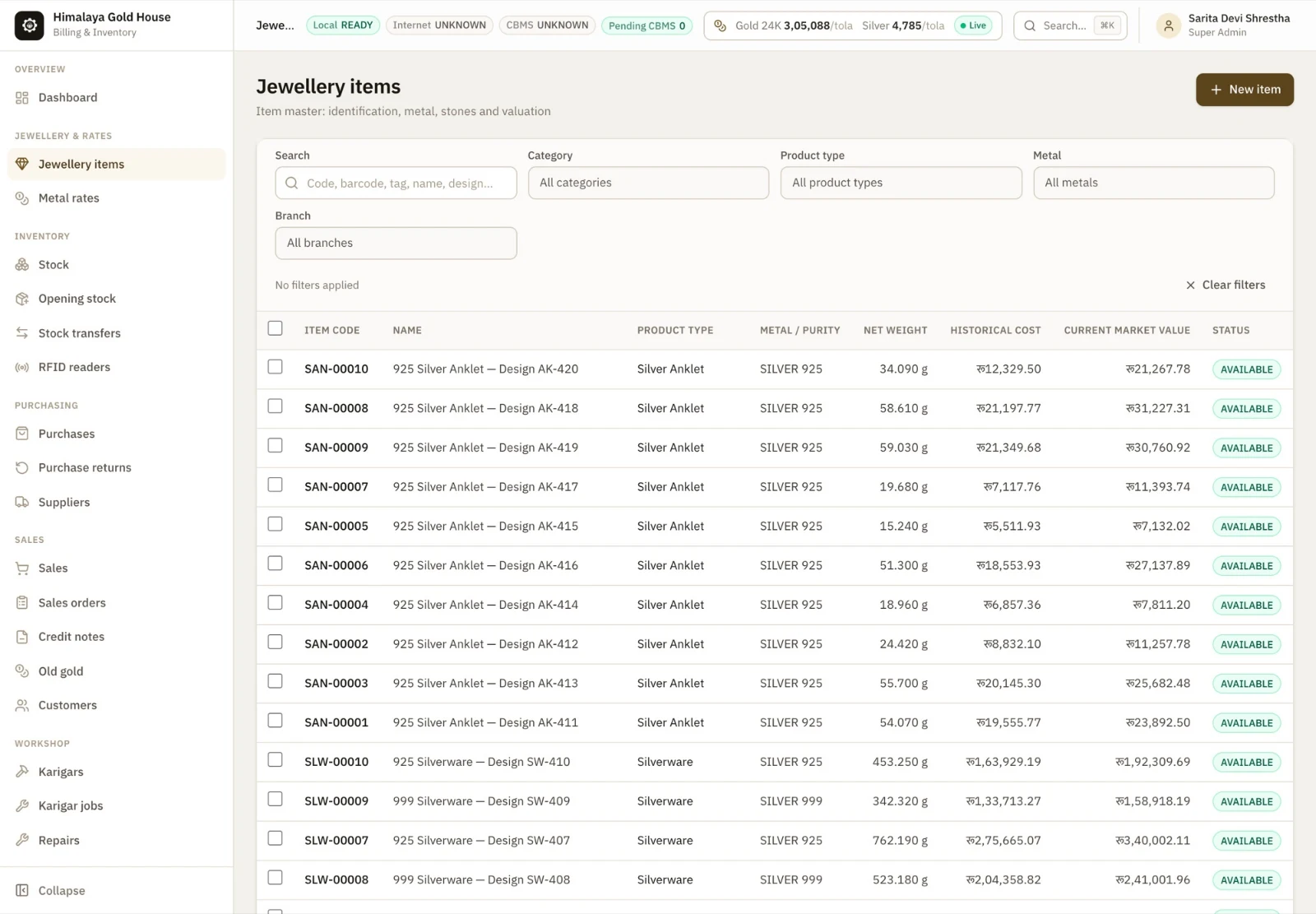
This is the screen, not a drawing of one.
Historical cost and current market value sit on the same row, beside weight and purity, so a piece can be priced and judged without opening anything else.
The same stock, read as a position.
One line per metal and purity: how many pieces, what they weigh, the fine weight inside them, and what that is worth at this morning’s rate.
See the demo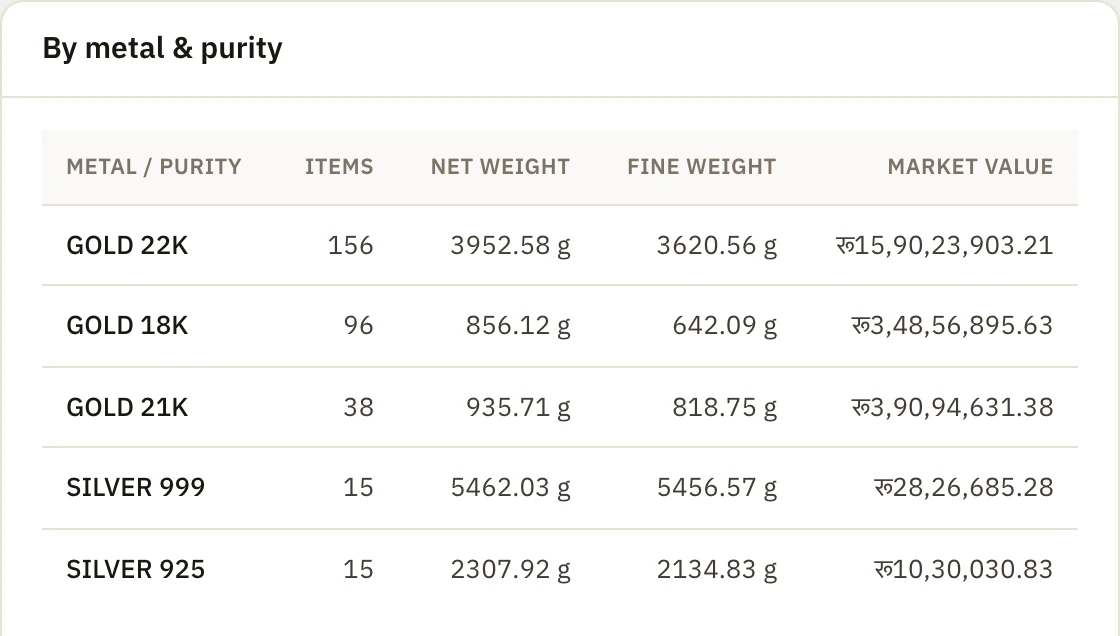
Access and trust
Your books stay yours.
A stock ledger is a list of where valuable things are, who bought them and what they paid. It is worth being careful about who can read it.
Who can do what
- Salesperson
- Bills a customer. Cannot change a finished invoice.
- Inventory staff
- Receives stock and moves it. Cannot see the ledgers.
- Accountant
- Payments, registers and reconciliation. Not stock adjustments.
- Branch manager
- The figures for their branch, and nothing from the others.
- Owner
- All of it, and the record of everything anyone else did.
And underneath it
Control what each person can reach
Use the ready-made roles, or build your own around the way your shop is staffed.
Everyone signs in as themselves
Which is what makes the record of who did what worth reading.
Every change is recorded
Who did it, what changed, and when — kept for you to look back through.
Finished documents stay finished
Corrected by credit note or cancellation, never quietly overwritten.
Billing survives a dropped line
Sales carry on offline and sync afterwards, without duplicating an invoice.
Your data stays yours
Export your records to CSV, Excel or PDF whenever you want them.
We set it up with you, and we teach your staff.
Your categories, your item codes, your branches and your opening stock are loaded before anyone is asked to use the system. Then the counter, the stock room and the office each get taken through the work they will actually do — on your own business, not a slide.
Pricing
One system. One plan. Nothing held back.
There are no tiers to work out and no feature you will discover you cannot use. Every jewellery business on DataJewellers gets the whole of it.
Complete
The whole jewellery system, for one business.
Contact us for pricing
What a shop pays depends on its size, and we would rather quote you properly than publish a number that does not fit.
Included
- Jewellery inventory, by weight and purity
- Gold and silver rates, per purity and per tola
- Stock valuation at cost and at market
- Sales, tax invoices and customer payments
- Purchases, suppliers and what is payable
- Karigar jobs, issue and reconciliation
- Repairs and old jewellery taken in exchange
- Branches, stock transfers and locations
- Printed tags and item codes, with barcodes
- Spreadsheet stock import, with rollback
- VAT registers by Nepali fiscal year
- IRD electronic billing, when you enable it
- Reports, registers and ledgers, exportable
- User roles and per action permissions
- Physical stock audits
- Audit trail and verifiable backups
- What happens if I stop subscribing?
- Nothing is deleted. The account stops taking new records, and everything you entered stays readable and exportable.
- Can I bring my existing stock in?
- Yes. Import a spreadsheet, preview it, and see every problem row before anything is written. A bad file rolls back as a batch.
- Do I need the IRD integration?
- Only if your business is VAT registered and enrolled for electronic billing. Tax invoices and VAT registers work without it.
- Can I get my data out?
- At any time, as CSV, Excel or PDF, for stock, customers, suppliers, sales, purchases, payments and every report.